

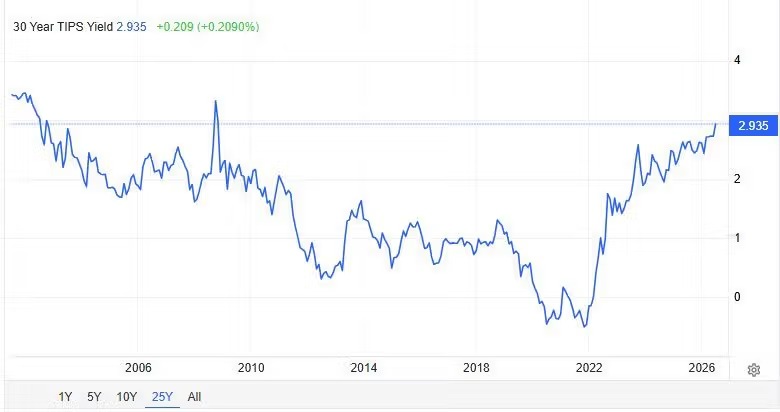
Foreign media believe that Bitcoin is facing a macroeconomic environment rarely seen since its inception: the long-term real interest rate in the United States has risen to a near 17-year high, significantly increasing the holding cost of non-interest-bearing assets. For the crypto market, this means that Bitcoin not only has to compete with risky assets for funding, but also with US Treasury bonds that can provide stable real returns.
The yield on 30-year TIPS is close to 3%.
The report mentions that the real yield on 30-year Treasury Inflation-Protected Securities (TIPS) in the United States has approached 3%. This means that if investors buy and hold these US TIPS, they can obtain an annualized return higher than inflation over the next few decades.
In traditional markets, government bonds are typically considered safe-haven assets. When these assets offer higher real returns, the appeal of assets like gold and Bitcoin, which do not generate interest, tends to be diminished. The market's focus is no longer just on inflation itself, but rather on "how much return is available after deducting inflation."
ETF funds temporarily hedge against interest rate pressures
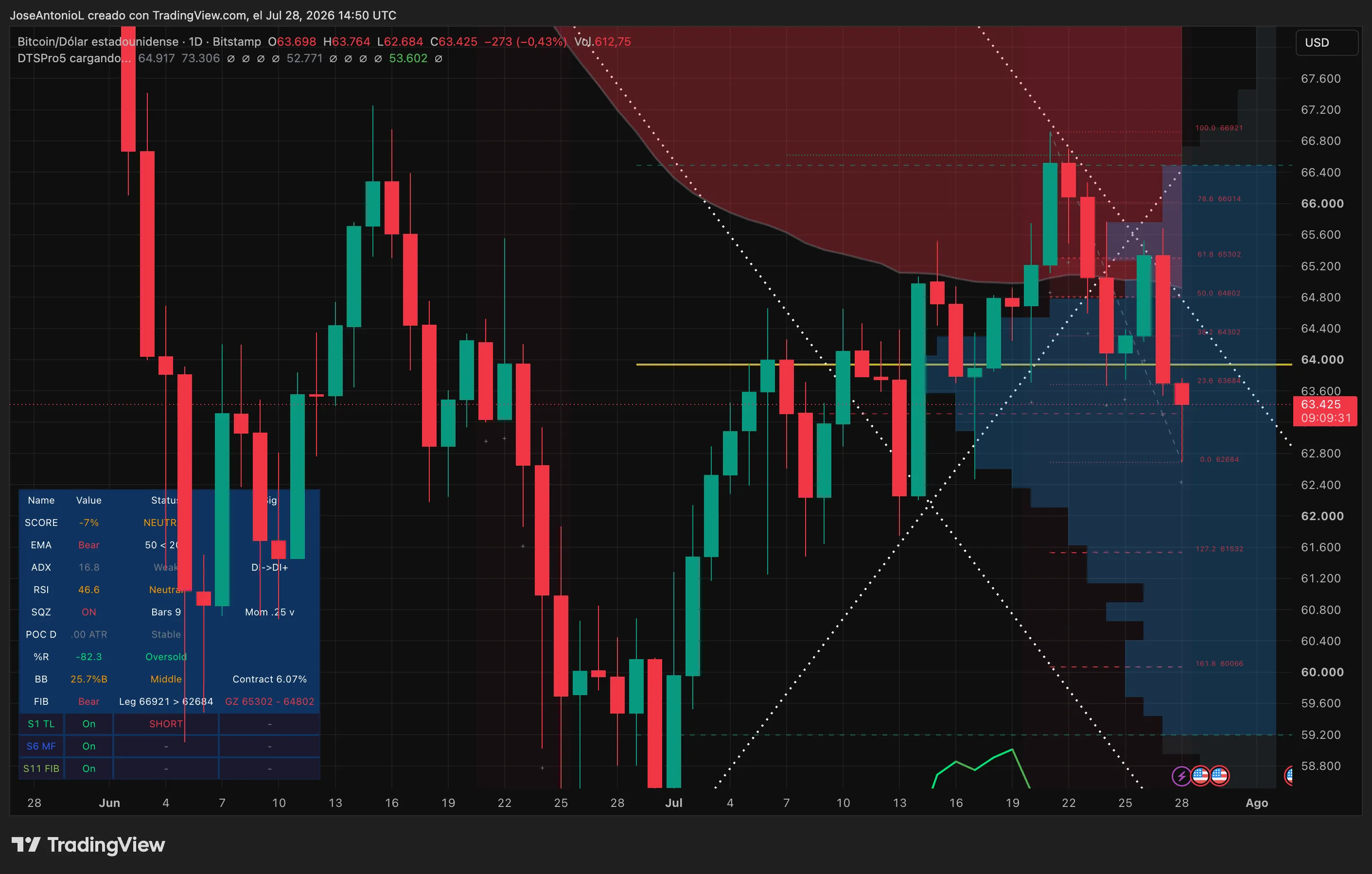
However, the article also points out that the current liquidity situation has not completely weakened. Spot Bitcoin ETFs have attracted nearly $1 billion in net inflows over the past seven trading days, indicating that institutional funds are still continuing to allocate funds.
- The real yield of 30-year TIPS is close to 3%.
- This level is at its highest in nearly 17 years.
- Nearly $1 billion flowed into spot Bitcoin ETFs in seven trading days.
This indicates that despite the pressure from high real interest rates, some investors still view Bitcoin as a store of value independent of the traditional financial system. The report cites the example of some real estate prices, which have significantly declined in Bitcoin terms compared to the past, as one of the reasons why supporters remain bullish.
If US stocks decline, the volatility could spill over into the cryptocurrency market.
The article argues that the next key question is whether changes in the bond market will trigger a broader asset rotation. If high real interest rates continue to suppress tech stock valuations, the decline in risk appetite could further spill over into the crypto market.
In other words, Bitcoin's current performance is not solely driven by factors within the crypto industry. US Treasury yields, the dollar's performance, and risk appetite in the US stock market are becoming significant factors influencing its short-term performance. Currently, ETF inflows indicate continued buying pressure, but if more pronounced risk-averse trading occurs in traditional markets, the volatility of crypto assets could amplify simultaneously.
BitMEX exits refraction derivatives integration
In addition to macroeconomic factors, the article also mentions that BitMEX will cease operations. As one of the earliest crypto trading platforms to launch perpetual contracts, BitMEX's exit is seen as a signal of accelerated consolidation in the crypto derivatives market.

The report suggests that the perpetual contract business is increasingly resembling a standardized market with high trading volume and low differentiation. For established platforms, failure to continue expanding liquidity and institutional business could lead to them being squeezed out by larger exchanges in the competition.